Helios Forge Fleet
HELIOS FORGE FLEET
Crypto Mining Management Platform
Helios Forge Fleet/Features/Fleet Management
Feature

ASIC Fleet Management & Monitoring

Discovery, inventory, grouping and monitoring — the layer that knows every machine you own, where it is, who it belongs to, and how healthy it really is.
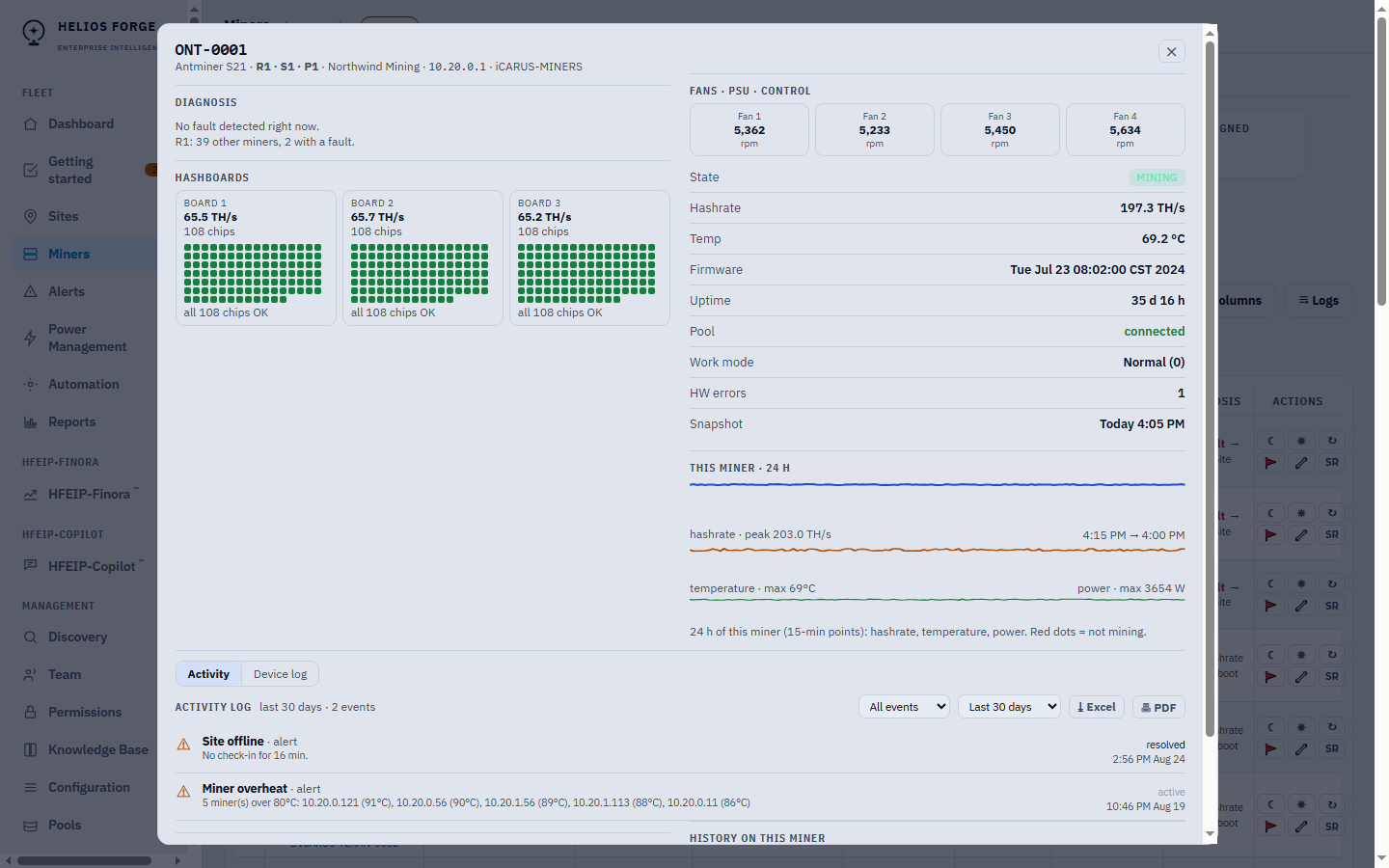
Helios Forge Fleet deep-insight view of one demo miner: three hashboards with per-chip health maps, fans, live telemetry and activity log
Product preview — illustrative demo data

Discovery and inventory

Point the site's Edge Agent at your approved subnets and it finds what's there. New machines land in a Discovery Inbox — you approve what joins the fleet, so a stray device on the network never silently becomes "inventory." Approved miners get durable asset IDs (the names on your QR labels, reports and invoices), with MAC capture so identity survives the address churn that real networks produce.

Monitoring that goes below the surface

The miner workbench shows the fleet as an operator actually triages it: sortable, filterable, problem-first, with your own choice of columns. Underneath the headline hashrate sits the evidence — per-board rates and temperatures, hardware errors, fan speeds, pool and worker status, and a chip map that marks each individual ASIC chip alive or failed. A board fading from 126 healthy chips to 120 is visible as exactly that.

Every miner's own device log is fetched on demand and interpreted into plain English, and a fleet-wide activity log records every command and its outcome — including the reason when something fails.

Grouping and lifecycle

Frequently asked questions

How are new miners added to the fleet? +
The site's Edge Agent scans the subnets you approve. Newly found machines appear in a Discovery Inbox for review — nothing joins your fleet silently — and each approved miner receives a durable asset identity that survives IP and hostname changes.
How deep does monitoring go? +
Beyond whole-miner hashrate: per-hashboard rates and temperatures, hardware-error counts, fan speeds, and a per-chip health map showing exactly which chips on which board have failed. Missing readings are shown as missing, never invented.
What happens when a miner is replaced or retired? +
Repair outcomes include replaced and retired. A retired machine leaves the active fleet automatically but keeps its history — its telemetry record, repairs and reports remain for reference and client billing accuracy.
Can I see why a miner is underperforming? +
Each miner has a deep-insight view combining live telemetry, per-board and per-chip evidence, its interpreted device log, and its repair history — so the diagnosis states what the evidence shows, in plain language.

Related

Every machine known, placed, and honestly measured.
Request a Demo