For owners and operators running whole facilities: Helios Forge Fleet manages the farm itself — sites and rooms, power and curtailment, teams and hosting clients, repairs and reporting — with every machine's individual management underneath it.
Create each facility, set its capacity and time zone, and install one Edge Agent per site network. Miners are discovered and inventoried automatically.
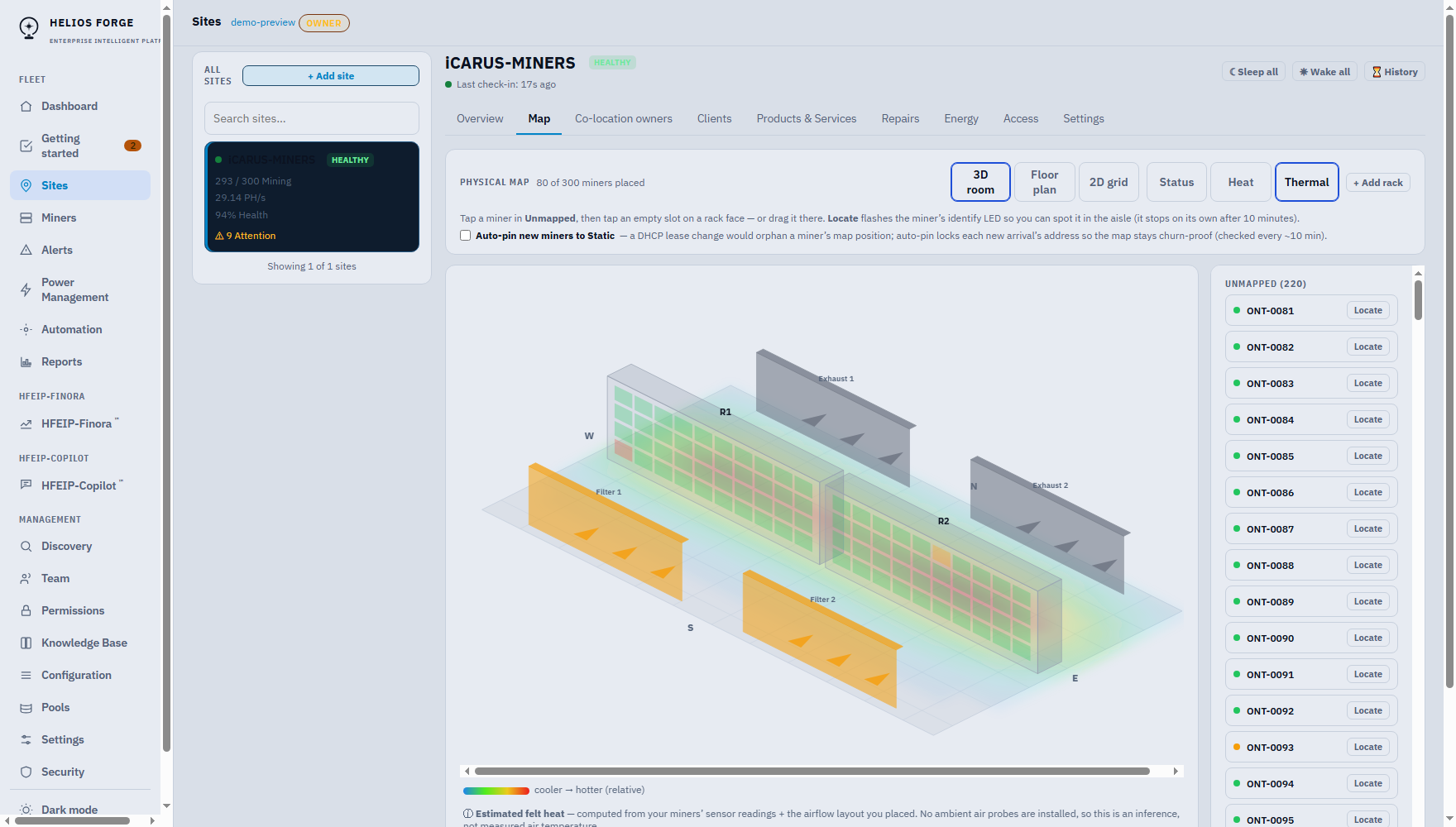
Lay out racks on a floor plan, add airflow elements, and place miners where they physically stand — by drag-and-drop, or by flashing a locate LED and placing what blinks.
Run power schedules, route alerts to the right people, track repairs, and hand owners and clients honest reports — all from one console.
Most mining dashboards stop at a table of IP addresses. Helios Forge Fleet models the room: racks with shelves and slots on a floor plan, water curtains and exhaust fans with their airflow direction, and a 3D view of the site as it actually stands. Every miner has a physical position, so "which machine is that" and "where is the hot corner" are answered by looking, not by walking the aisles with a clipboard.
The same map recolors on demand: machine status at a glance, per-miner chip temperature, or an estimated felt-heat view of the room's air computed from the miners' own sensors and your airflow layout — always labeled as the estimate it is, because the platform's standing rule is that it never dresses inference up as measurement.
Site capacity and live load sit side by side, and curtailment is a schedule rather than a scramble: sleep windows around time-of-use pricing, verified wake-ups afterwards, and per-client opt-in so hosting customers control participation. A curtailed site is marked as intentionally offline — the platform won't wake you at 2 a.m. for downtime you planned. The full detail lives on the power management page.
Organizations are strictly isolated; within one, roles run from owner to view-only. Hosting clients are first-class: each co-location account owns specific miners, gets its own portal logins, sees published service reports, and appears in billing with an estimated energy share and services. QuickBooks connects for the accounting side.
Repair tickets track a machine from fault to fix — or to replaced/retired, with the fleet records updating automatically. Service reports build themselves from the live diagnosis and repair history, go from draft to final under your control, and publish to the client's portal when you say so.
This product exists because its builders ran farms first: the site build-outs, the airflow experiments, the TOU bills, the client phone calls. The farm layer of Helios Forge Fleet is shaped around those realities — planned downtime that doesn't false-alarm, maps that match the room, and reports a client can be handed without translation.